Error converting content: marked is not a function
- Clay Design - https://dribbble.com/shots/19480095-JOKR-UI-Kit - Business Operations Metrics id:: 629b9abd-5c83-47f1-8790-ce876f54c6f8 collapsed:: true - Source: Slack, [JOKR Playbooks](https://sites.google.com/jokr.it/jokr-paybooks/home) id:: 629b83d9-20b1-4b67-8527-9ff8eb49a320 - fill rate, otif; 1000 orders in US per day - 1620 highest volume sales - weekly - 7-8k orders, 88% otif (9 3) - playbook - hub daily opeartionsl checklist https://docs.google.com/presentation/d/1LLH7k8_KoGjhJzWFROl9c6DihUF_uz5100i6eFceeAM/present?slide=id.g1043488b813_1_5 - supply vhsin plsybook https://sites.google.com/jokr.it/jokr-paybooks/operations/supply-chain?authuser=0 - metrics reports - https://sites.google.com/jokr.it/jokr-paybooks/data/data-reports?authuser=0 - tech stack - from app to data — need. 2x2 map - Scale metrics - Orders per day, per month - DAU, MAU, app installs total, monthly - Catalog - Jun 19th, 2022 collapsed:: true - Nice Email from @Ralf Wenzel - And when we say family first, we mean it. Take a call on the road. Bring your kids on video, or turn it off when needed. Take time off, start the day late, end the day early. We are all adults, and we all find a way to get the work done. We trust and support each other to make it happen! And despite the challenges of integrating a busy work life with a busy home life, I hope you find both just as rewarding as I do. Here’s to the JOKR dads, all of our dads, father figures, and those missing their dads. We’re sending extra gratitude to you today. - ## Salary and Grants - 2021 September - Base: $300,000 - Option Grant: $739,980 - 28,179 @$26.26, 4 year vesting starting Sep 1st, 2021, 1 year cliff - About $185K vested yearly - 2022 July - Option Grant: $157,456 - 7045 @$22.35, 4 year vesting starting Jul 1st, 2022 , 1 year cliff yikes - About 40k worth of options to buy this year - Timeline collapsed:: true - Sep 1st, 2021 Day 1 - Aug 9th, 2021 accepted JOKR offer - Jul 11th, 2021 Sunday Musing on JOKR. Email I wrote to @Sven G collapsed:: true - Hi Sven - thanks for meeting with me on Thursday (07/08) and sharing your thoughts on Jokr's mission and the current technology stack. I enjoyed our discussion and I am really impressed with how quickly Jokr has grown and expanded into several countries with a working mobile app and localized operations. I believe this is a true testament of the real world experience that Jokr leadership brings in from the delivery, logistics and consumer product space. I am looking forward to meeting with other folks and you again. - I wanted to share something that clicked in my head after my discussion with you and my further research on Jokr's mission. I read [Zachary Dennett's interview with Grocery Drive](https://www.grocerydive.com/news/the-instant-delivery-race-heats-up-further/601220/) and the following paragraph had something click in my head: - > - **Does 15-minute delivery really make that much of a difference to consumers?** **DENNETT: **With 1- or 2-hour delivery, the consumer is still planning in advance. That’s not a customer-centric number — it’s the fastest that the mainline grocers are able to do it with their existing infrastructure. What we've seen as we've launched in other countries, and **what we're starting to see in our early testing in New York, is that 15-minute delivery changes the way you shop.** Customers first try us out because they forgot an ingredient. Then they use us the next night for all their dinner ingredients. And then your mindset changes. Suddenly, you completely change the way you plan meals for the week. Rather than planning out dinners, you decide what you want to cook right before you start cooking it. That's a very different shopping mentality. It completely turns the stock-up trip on its head. - I am prone to connecting real world phenomena to computer and software analogies (and vice versa) so allow me to offer one: - My observation is that not everybody groks performance in software engineering. Performance is not just about speed. When something can be done faster it has the power to affect and change the context that bounds it. It incentivizes sophisticated (yet much simpler) workflows and behavior previously assumed to be costly and cumbersome. - The example I like is the story of Git and how it changed software development and delivery forever. Linus Torvalds built Git in 2007 due to his annoyance with how slow and conflict driven 'code merging' was with SVN and other source code management tools of the day. Linux was open source and there were 100s of new patches being delivered to it everyday but the tooling and infrastructure of the day really did not allow for such rapid workflows. Here is snippet from[ Linus's talk at Google back in 2007](https://www.youtube.com/watch?v=4XpnKHJAok8&t=2439s) when he introduced Git: - 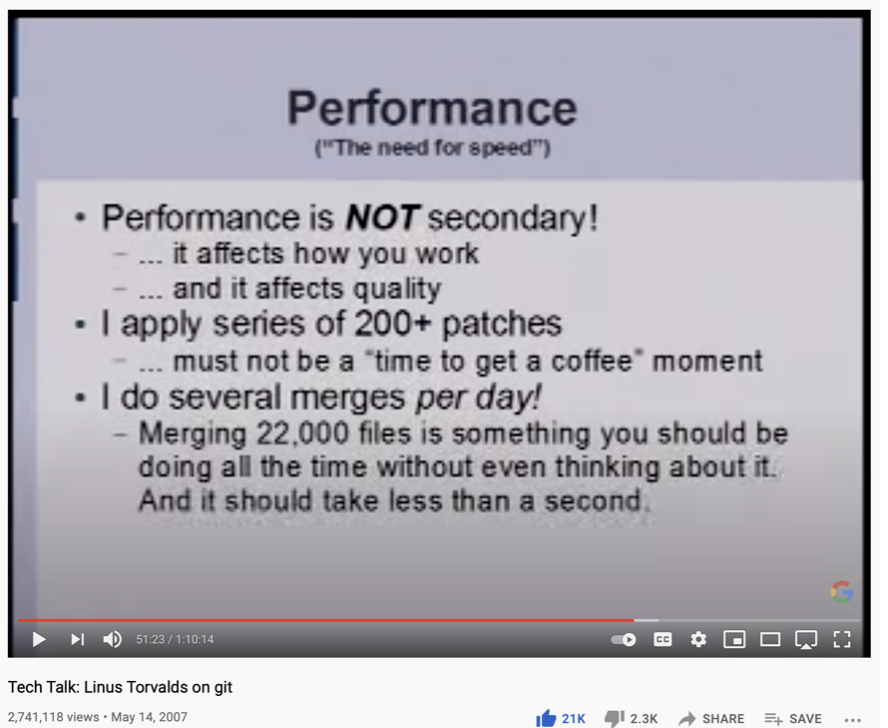{:height 228, :width 272} - _"__One of the things I want to say about performance is a lot of people seem to think that performance is about doing the same thing, just doing it faster. And that's not true. That's not what performance is all about. If you can do something really fast really well, people start using it differently.__ _ - _One of the things I wanted to make sure is that merges go really, really quickly because I want people to merge often and merge early because it turns out it becomes easier to merge. If you merge every day, suddenly you never get to the point where you have huge conflicts that are hard to resolve. If you actually make branching and merging easy, you actually avoid a whole class of problems that you otherwise __have a really, really hard time avoiding."_ - Git changed developer behavior and revolutionized how software is built and delivered (including open source development). Today we branch and merge code on impulse. Back in 2008 I had to block a meeting with my tech-lead and plan a special 'merge day'. Long standing development branches were considered normal, in fact, it was the best practice. AFAIK (at least from a developer's perspective) continuous delivery of software was never a pipe dream. The limitation of our infrastructure could have us think in such blasphemous terms. So what does this have to do with Jokr? When I read "**15-minute delivery changes the way you shop."**, it resonated with me as I could see how such disruptive improvement in delivery performance can change the context that binds it - if executed well, it has the potential to change shopping behavior for "just in time" products and bring workflows and use-cases that I don't I (wearing a consumer hat) have thought of just yet. I can see myself ordering healthy ingredients from Jokr instead of restaurant food from Uber Eats/Doordash when I am hungry. I can get generic medicine when I need it instead of stockpiling them which leads to expiration and wastage… etc. The product that would eventually unfold would not be the current e-commerce app but a totally different experience that most consumers don't even know they need - limited in their pipe dreams by the current infrastructure, tools and services. It is likely that such fast delivery times would enable novel supplier side changes as well. That is indeed an exciting prospect. I may have stretched my analogy a bit and I could be wrong but I thought I would share my Sunday musing with you as this got me excited. - - Thanks, - Sid S - Jul 8th, 2021 Connected with @Sven G via recruiter - Team Stuff - Team Outing - Jul 18th, 2022: July team outing the @Gabi JOKR and @Simon Vuong at @Places/Zou Zou, NYC and my rooftop id:: 62d67ae3-4575-4c8c-8d31-73ba832f8730